

The Violence of Productivity
How productivity is weaponized to control, exploit, and erase our humanity.

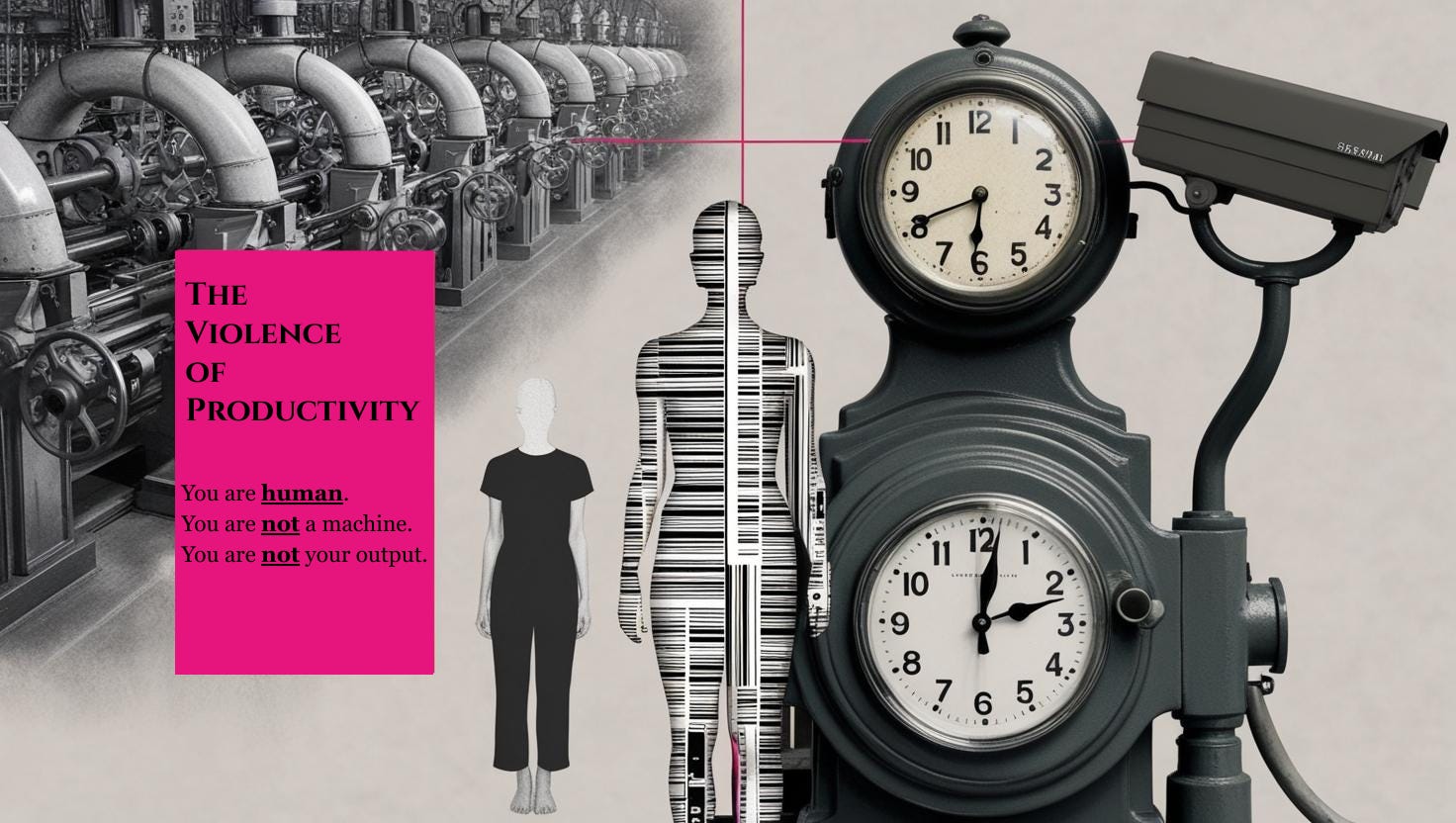
The American obsession with work has turned labor into a moral currency—and workers into commodities.
I saw a comment on TikTok that completely blew my mind. The Speech Prof was talking about his struggles with executive function due to ADHD—how it affected his productivity and made him appear lazy when he wasn’t. The comment read:
“Laziness is a capitalistic construct. A thriving human has a desire to create, expand, share and find fulfillment. ‘Laziness’ isn’t a personal flaw. It’s a symptom.”
There’s a cruel irony at the heart of American identity: the harder you work, the more virtuous you’re assumed to be—yet the less you own of your time, your body, and your life.
This is no accident.
Let’s take a look back at the Protestant Reformation. It’s no coincidence that the regions of Europe most impacted by it were also the first to adopt a new concept of the person. The Reformation wasn’t just about reforming the church—it was about reforming the individual, the body. Rooted in Calvinist theology, the Protestant work ethic taught that salvation wasn’t guaranteed, so devout Protestants sought signs that they were among God’s chosen. Wealth and success, conveniently, became those signs. The assumption was that both were earned through hard work.
Work wasn’t merely labor. It was proof of moral worth.
This belief became central to the ethics of the ruling class. For capitalism to function, it had to transform our life’s purpose from living to producing—while transforming the ruling class’s purpose into acquiring.
The system requires us to overcome our natural state of being by disconnecting from nature itself. The workday was extended past sunset. Seasonal rhythms were ignored. Time was restructured around the productive workday. Karl Marx called this the “alienation of the body,” arguing that under capitalism, workers no longer saw themselves as people, but as tools of labor. Silvia Federici writes in Caliban and the Witch:
“By transforming labor into a commodity, capitalism causes workers to submit their activity to an external order over which they have no control and with which they cannot identify…the worker becomes the ‘free owner’ of ‘his’ labor power, which (unlike the slave) he can place at the disposal of the buyer for a limited period of time.”
During the shift from feudalism to capitalism in Europe, peasants and artisans didn’t quietly accept the new system. The ruling class learned that displacing peasants from communal lands wasn’t enough to force them into wage labor. Many people preferred begging or vagrancy to accepting this new order. In fact, resistance was so fierce that many chose execution over submission. Countless peasants were hanged for refusing to enter the wage labor system.
To control and exploit the labor force, authorities had to suppress any behavior that resisted “a stricter work-discipline.” By the mid-16th century, both England and France had outlawed games—especially games of chance like cards and dice. Taverns and public baths were shuttered. New laws criminalized drinking, swearing, vagrancy, nudity, and many forms of sexual expression deemed “unproductive.”
Recreation was criminalized.
They couldn’t completely devalue the body—it was still the source of labor power. But everything mysterious, natural, pleasurable, or magical about it had to be destroyed. The body, as it had been understood for millennia, had to die so that its labor could live.
Fast-forward to American capitalism. The theology was stripped of God (though not for everyone), but the punishment remained. Work became sacred. Rest became guilt. Suddenly, your humanity was only valid if it could be monetized. And somewhere along the way, “appearing” engaged with your work became more important than actually being engaged.
To survive in a capitalist system, you’re forced to treat your labor and your skills as commodities—and, in turn, to see yourself as a commodity to be bought and sold.
As industrial capitalism matured, labor came to be treated like any other good—bought and sold on the market like wheat or steel. This didn’t just reshape the economy. It fundamentally altered how we see ourselves. Workers were no longer craftspeople, creators, or thinkers. They were units of labor power—valued not for who they were, but for what they could produce.
And here’s the kicker: the more alienated you become from your labor, the easier it is for power structures to exploit you.
When you don’t own the product of your work…
When your time is ruled by the clock…
When your worth is calculated in output metrics…
You begin to disassociate from your own body.
Your needs become disruptions.
Your exhaustion becomes weakness.
Your dreams? Irrelevant.
This isn’t just economic. It’s deeply gendered and racialized.
Women—especially women of color—have long been expected to perform invisible, unpaid labor that props up the very system that devalues them. From caregiving to emotional labor to the societal expectation of being endlessly “available,” we’re taught that our productivity is our power—but only when it serves someone else’s bottom line.
So when a Black woman burns out from caretaking while holding down two jobs, society calls it a personal failure—not a systemic collapse.
When a middle-aged woman with chronic illness can’t “lean in” because she’s exhausted, sick, and already stretched too thin, the narrative blames her ambition—not capitalism’s cruelty.
We need to reject this narrative.
You are not your job title.
You are not your productivity.
You are not the unpaid labor keeping this system afloat.
You are not a commodity.
You are a human being—with needs, with limits, and with the right to rest, rebel, and reclaim your life.
yes 🙌🏽